An electric ball valve for a gas analysis project should be evaluated as part of the measurement path, not as a generic on-off component. The purchase specification needs to define what passes through the valve, the pressure and temperature at the valve, port arrangement, wetted materials, shutoff requirement, connection size, actuator power and control signals, cycle duty, feedback and power-loss position. Those fields determine whether the valve can isolate, select or drain a line without slowing the system or affecting the sample. A low unit price has little meaning when the quoted valve does not match the actual fluid circuit or control architecture.
The Valve Duty Comes Before the Valve Size
Gas analysis systems can use electrically operated valves at several points: sample selection, calibration-gas admission, bypass isolation, condensate discharge or switching between process streams. These duties are not interchangeable. A valve exposed only to clean calibration gas faces different material and cleanliness demands from one handling wet sample gas or collected condensate.
Begin with a one-sentence duty statement. It should identify the fluid, normal direction of flow, expected valve state, switching frequency and the consequence of leakage. Buyers reviewing gas analyzer auxiliary accessories can then compare the valve against the surrounding probe, filter, cooler, pump and tubing instead of treating it as a stand-alone catalog item.
| Valve duty | Information to define | Why it changes the selection |
| Sample isolation | Gas composition, normal pressure, temperature, particles and condensate risk | These conditions affect wetted materials, sealing and the possibility of contamination or sticking. |
| Stream or calibration selection | Number of ports, flow sequence, permitted cross-port leakage and switching time | Port logic and internal volume influence whether one stream can carry over into the next measurement. |
| Condensate drain | Liquid composition, drain pressure, solids and required opening duration | A valve suitable for clean air may not be suitable for acidic or particulate-bearing condensate. |
| Safety or shutdown isolation | Required position after power loss, feedback and shutdown logic | The actuator behavior must agree with the control philosophy rather than being assumed from the word “electric.” |
A ball valve is normally chosen for positive on-off or switching service. If the project requires repeatable throttling, the buyer should state that explicitly and verify that the offered valve and actuator are designed for modulating duty. A standard quarter-turn shutoff assembly should not be treated as a control valve merely because it can stop at an intermediate position.
Confirm the Actual Fluid, Including What Appears During Upsets
“Air service” is not a complete description for an analyzer valve. The stream may contain corrosive gases, water vapor, aerosols, dust or cleaning fluid. Cooling can also create liquid where the process description initially lists only gas. The correct material check therefore covers the valve body, ball, stem, seats, seals and every other wetted part.
Compatibility affects more than corrosion. Some sample components can be adsorbed by surfaces or trapped in dead spaces, while particles may score seats and condensate can increase operating resistance. Those effects may alter response, create memory between streams or prevent complete shutoff. The supplier needs the expected gas matrix and abnormal conditions, not just the name of the primary analyte.
Cleanliness also deserves a purchase definition. A calibration line may require protection against oil, assembly debris or cleaning residue. For a drain valve, the more important question may be whether the internal passage can clear liquid and suspended matter. These are different acceptance problems, even if both valves use the same nominal connection.
Pressure, Temperature and Cycling Determine Actuator Demand
Actuator sizing cannot be separated from valve operating conditions. Published engineering guidance for actuated ball valves shows that required operating torque can change with system pressure, temperature, seat material, process medium and cycle frequency. This is why a valve that moves freely during an unloaded bench check may behave differently after installation.
The RFQ should give normal and maximum pressure on each relevant port, the maximum differential pressure during switching, minimum and maximum fluid temperature, ambient temperature and expected cycles per hour or day. The supplier can then confirm that the integrated valve-actuator assembly has adequate margin for the real duty. A motor power figure alone does not demonstrate that the valve will open and close under the specified differential pressure.
Cycle frequency matters in another way: it defines how quickly a slow or unreliable valve affects data availability. A stream-selection valve may operate many times per shift, while an isolation valve may remain in one position for weeks. Long idle periods, frequent cycling and intermittent condensate exposure present different failure risks. The quotation should identify the duty used for selection and any limitation that depends on cycling.
Port Geometry and Internal Volume Affect Measurement Quality
Nominal connection size does not reveal the internal flow path. The buyer also needs the number of ports, bore or effective flow area, port mapping and flow coefficient when pressure drop is important. A restriction can reduce sample flow and extend transport time. Excess internal volume can lengthen purge time when switching from process gas to zero or span gas.
For multi-stream systems, the drawing should make the relationship between actuator position and connected ports unambiguous. Terms such as normally open, normally closed, L-port and T-port are not enough unless the supplier shows the port numbering and switching positions. The controller logic, tubing drawing and valve diagram must describe the same flow path.
Leakage has two distinct meanings here. External leakage is a containment issue; internal seat leakage can mix isolated streams or admit ambient air. The acceptable test method and limit should therefore be connected to the valve duty. A small cross-port leak that is irrelevant in one utility circuit can bias a low-level measurement or disturb a calibration sequence in another.
The Electrical Interface Must Match the Control Philosophy
An electric actuator specification needs more than supply voltage. Record the voltage and allowable variation, steady and starting current, control input, number of wires, switching logic, travel time, position indication, end-of-travel behavior and connector or cable arrangement. If the control cabinet expects dry contacts but the valve requires a maintained voltage signal, the mismatch will appear only during wiring or commissioning.
Power-loss behavior should be written as a required physical position, not a vague request for a “safe” state. The correct state depends on the circuit. A calibration valve may need to close, a drain valve may need to remain closed until commanded, and another application may require a defined return position. If the actuator does not provide automatic return, the system designer must decide how the process will respond after power interruption.
Position feedback is equally specific. An open/closed command does not prove that the ball reached the commanded position. Where verification matters, the buyer should define whether limit switches, an auxiliary contact or a position signal is required and how the control system will handle disagreement between command and feedback.
Evaluate the Valve Inside the Sample-Conditioning System
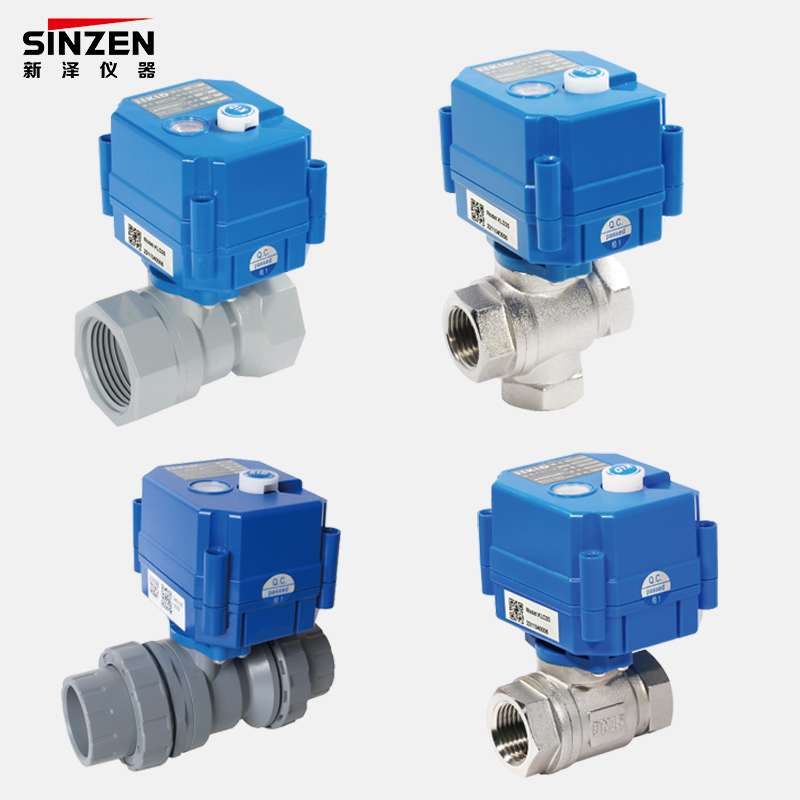
SINZEN lists a compact Electric Ball Valve for voltage-signal control of water or air flow paths. That published scope provides a useful product entry point, but project approval still depends on the fluid circuit, environmental conditions, connection details and control requirements supplied for the order.
The surrounding components can change the valve duty. A cooler may create condensate, a pump may place one section under vacuum, a blocked filter may increase differential pressure, and a heated line may expose the valve to a higher temperature than the analyzer cabinet. The project drawing should show the valve location relative to these components so that the rating check is based on local conditions rather than the process stack condition alone.
Installation orientation, service access and tubing support also belong in the review. A compact actuator still needs cable clearance and space for removal. Unsupported tubing can load a small valve body, while a drain arrangement may require gravity flow and a predictable low point. These details often determine whether maintenance can be completed without disturbing neighboring instruments.
Build Acceptance Around Evidence, Not Descriptions
A quotation may describe two valves with the same generic name while offering different materials, actuators and documentation. The evidence package should make those differences visible before the purchase order is released.
| Evidence requested | What it should confirm | Procurement value |
| Product datasheet | Pressure and temperature limits, materials, port arrangement, electrical supply and duty | Shows whether the quoted configuration matches the stated operating envelope. |
| Dimensional and port drawing | Connections, flow positions, envelope, cable exit and installation orientation | Prevents mechanical and tubing-interface surprises during assembly. |
| Wiring or control diagram | Command logic, feedback, current demand and power-loss behavior | Allows the control cabinet and software logic to be checked before commissioning. |
| Functional and leakage record | Opening, closing, feedback and the agreed leakage check | Links acceptance to the actual duty rather than a visual inspection alone. |
| Deviation list | Any difference from the RFQ, drawing or requested document scope | Keeps optional or substituted features from being discovered after delivery. |
Prepare an RFQ That Produces Comparable Quotations
A useful electric ball valve RFQ identifies the valve duty, medium and possible condensate, normal and maximum pressure, differential pressure, temperature range, port arrangement, connection, wetted materials, cycle frequency, supply voltage, command signal, feedback, travel time, required power-loss position, leakage expectation, quantity and documentation. Attach the relevant flow or tubing drawing when the valve position affects stream selection.
Ask each supplier to return the offered configuration, ratings, material list, electrical interface, included connectors or cables, test scope, document scope and every deviation. This creates a common technical baseline before price and delivery are compared. Project data can be submitted through SINZEN’s gas analysis project inquiry form for configuration review and quotation alignment.