An Online Flue Gas Monitoring Analyzer helps industrial facilities measure key exhaust-gas components continuously or near-continuously, turning stack conditions into usable operational and environmental data. For boilers, furnaces, incinerators, kilns, power-generation units, and process-heating systems, the right analyzer can support combustion optimization, emissions reporting, maintenance planning, and more informed environmental management.
Rather than treating emissions monitoring as a stand-alone compliance task, many operators now use online data to connect fuel use, air supply, process stability, and pollution-control performance. The value depends on selecting a monitoring solution that matches the real flue-gas conditions, required parameters, applicable regulations, and site maintenance capability.
What Does an Online Flue Gas Monitoring Analyzer Measure?
An Online Flue Gas Monitoring Analyzer is typically part of a broader continuous emissions monitoring system (CEMS). Depending on the application, it may measure gases such as:
- Oxygen (O₂)
- Carbon monoxide (CO)
- Carbon dioxide (CO₂)
- Nitrogen oxides (NOx)
- Sulfur dioxide (SO₂)
- Hydrogen chloride (HCl)
- Ammonia (NH₃)
- Moisture
- Other application-specific gas components
Some systems also integrate particulate, opacity, temperature, pressure, flow, and data-acquisition functions. The appropriate parameter list should be defined by the process, fuel type, emission-control equipment, permit conditions, and local monitoring requirements—not by a generic analyzer specification alone.
For example, oxygen data can help evaluate excess-air control in combustion processes, while NOx, SO₂, CO, or CO₂ monitoring may be needed for emission management, process optimization, or reporting. A facility should first clarify whether it needs gas concentration, mass-emission calculation, combustion control input, regulatory reporting data, or a combination of these outcomes.
Why Continuous Flue Gas Monitoring Matters
Manual stack testing provides valuable point-in-time information, but it may not reveal process variation between tests. An online monitoring system can help operators see trends caused by fuel changes, burner imbalance, air leakage, load variation, reagent performance, or equipment deterioration.
A well-designed Online Flue Gas Monitoring Analyzer can support several business and operational objectives:
- Earlier identification of abnormal combustion conditions
- Better visibility into emissions-control performance
- Faster troubleshooting after process changes
- More consistent data collection for internal reviews
- Improved maintenance planning for probes, filters, pumps, and analyzers
- Better records for site-specific environmental reporting workflows
Continuous data is not automatically “compliance-ready” simply because an analyzer is installed. Accuracy, calibration, quality assurance, sample representativeness, data handling, and local regulatory requirements all affect whether the results can be used for official reporting. This distinction is important when selecting equipment and planning a project.
Main Types of Online Flue Gas Monitoring Analyzer Systems
Extractive Monitoring Systems
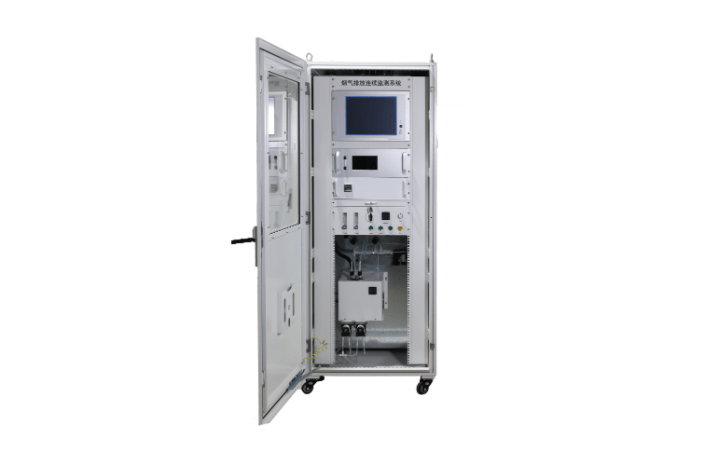
An extractive system draws a flue-gas sample from the stack or duct through a probe and sample line to an analyzer cabinet. The sample may be filtered, heated, cooled, dried, or otherwise conditioned before measurement.
This approach can be suitable when the process requires a protected analyzer environment, multiple gas measurements, or detailed control of sample treatment. However, the sampling path must be designed carefully. Condensation, particulate loading, corrosive gases, leaks, temperature loss, and poor sample transport can affect data quality.
Key selection questions include:
- Is a hot-wet or cold-dry extraction method appropriate?
- What sample conditioning is necessary?
- Are heated sample lines required?
- How will filters and probe components be maintained?
- Can the system prevent water-soluble or reactive gases from being lost during sample handling?
In-Situ Monitoring Systems
In-situ analyzers measure directly in the stack or duct, without transporting a gas sample over a long line. Depending on the technology, the analyzer may measure across the duct or at a defined point.
In-situ monitoring can reduce some sample-conditioning requirements and may offer a fast response for certain applications. However, the installation environment is demanding. Optical path cleanliness, probe temperature, vibration, dust, corrosion, stack geometry, and access for maintenance should all be assessed before choosing this configuration.
Hybrid and Integrated CEMS Solutions
Some facilities need more than one measurement method. An integrated system may combine gas analyzers with flow monitoring, opacity or particulate instruments, meteorological inputs, data acquisition, alarms, and reporting functions.
The best architecture depends on the source and monitoring objective. A compact combustion-control analyzer for a small boiler does not necessarily require the same design as a full CEMS for a large industrial stack.
Critical Factors When Selecting an Analyzer
1. Understand the Gas Matrix
The flue gas itself determines much of the system design. Before selecting an Online Flue Gas Monitoring Analyzer, document the expected temperature, pressure, moisture level, dust burden, corrosive components, gas concentration range, and possible interfering gases.
A system that performs well in clean, dry exhaust may not be suitable for hot, wet, dusty, or corrosive flue gas. Accurate selection starts with real operating conditions, including upset conditions and start-up or shutdown periods.
2. Define the Required Measurement Range
The analyzer range should be suitable for normal operation and expected variation. A range that is too narrow can cause frequent overload conditions; a range that is too wide can reduce useful resolution in the operating area.
Facilities should review historical process data, fuel specifications, design calculations, and regulatory limits when defining ranges. If the process has several operating modes, the system may need multiple ranges or a configuration that remains reliable across expected changes.
3. Match Technology to the Measurement Objective
Different gas components and measurement conditions may require different analytical principles. The choice should consider detection requirements, potential cross-interference, response time, sample conditioning, maintenance workload, and expected long-term stability.
The right question is not simply, “Which analyzer is most advanced?” It is, “Which measurement approach can reliably produce the required data in this specific flue-gas environment?”
4. Plan for Calibration and Quality Assurance
Calibration access, calibration-gas management, zero and span checks, drift evaluation, maintenance records, and data validation should be planned before installation. These processes are essential for maintaining confidence in the data.
A low initial equipment price can become expensive if the analyzer requires difficult access, frequent unplanned servicing, or specialized consumables that are not available locally. Lifecycle cost should include installation, commissioning, calibration, preventive maintenance, spare parts, operator training, and data-system support.
5. Review Installation Location and Access
The sampling or measurement location should be representative of the gas stream and practical for safe maintenance. Poor access can increase downtime and make routine work difficult. Important considerations include:
- Duct or stack geometry
- Gas-flow profile
- Distance from control equipment
- Available platform and service access
- Ambient temperature and weather exposure
- Electrical and instrument-air availability
- Cable, sample-line, and drainage routing
- Safety procedures for maintenance personnel
From Analyzer Data to Better Plant Decisions
The strongest monitoring projects connect data to action. Alarm limits, trend review, maintenance triggers, and response procedures should be agreed before commissioning.
For example, an unexpected oxygen increase may indicate air ingress, excess-air adjustment, or a process change. A shift in CO may point to incomplete combustion. Rising pressure drop or unstable readings may signal sample-path fouling or a maintenance issue. The analyzer does not replace engineering judgment, but it gives operations teams a more timely starting point for investigation.
Facilities can gain more value when process engineers, environmental teams, operators, and maintenance personnel agree on:
- Which readings require immediate action
- Which changes should trigger a maintenance inspection
- How calibration and downtime are recorded
- Who reviews trends and reporting data
- How invalid or missing data are identified and handled
- Which operating changes need follow-up verification
A Practical Procurement Checklist
Before purchasing an Online Flue Gas Monitoring Analyzer, confirm the following:
| Selection Area |
Questions to Ask |
| Process fit |
Which source, fuel, process stage, and operating modes will be monitored? |
| Gas parameters |
Which gases and supporting variables must be measured? |
| Measurement purpose |
Is the goal combustion control, environmental reporting, process optimization, or all three? |
| Site conditions |
What are the temperature, moisture, dust, pressure, corrosion, and interference risks? |
| System design |
Is extractive, in-situ, or hybrid monitoring the better fit? |
| Data handling |
How will data be logged, displayed, alarmed, retained, and reviewed? |
| Maintenance |
Who will perform calibration, inspection, replacement, and troubleshooting? |
| Regulatory fit |
What local permits, approved methods, performance tests, and QA requirements apply? |
| Lifecycle cost |
What are the expected costs for installation, service, consumables, spares, and training? |
Conclusion
An Online Flue Gas Monitoring Analyzer is most effective when it is selected as part of a complete monitoring strategy rather than as an isolated instrument purchase. The right solution should match the gas conditions, parameters, data purpose, installation environment, maintenance resources, and applicable local requirements.
For a project-specific discussion of flue-gas monitoring configurations, analyzer selection, or technical support, contact SINZEN Gas.
FAQ
What is an Online Flue Gas Monitoring Analyzer used for?
It is used to measure selected gases in industrial exhaust streams, helping facilities monitor combustion performance, emissions trends, process conditions, and environmental-control equipment.
Which gases can an Online Flue Gas Monitoring Analyzer measure?
Common parameters include O₂, CO, CO₂, NOx, SO₂, HCl, NH₃, and moisture. The actual configuration should be based on the process, fuel, emission source, and monitoring objective.
Is an online flue gas analyzer the same as a CEMS?
An analyzer is an important part of a CEMS, but a complete system may also include sample handling, probes, calibration functions, data acquisition, reporting, flow measurement, and quality-assurance procedures.
How do I choose between extractive and in-situ monitoring?
The decision depends on gas temperature, moisture, dust, corrosion, required parameters, response needs, installation constraints, and maintenance capability. A site assessment is usually needed before final selection.
Can online monitoring data be used for regulatory compliance?
It may be used when the full system, installation, performance verification, quality assurance, data handling, and operating procedures meet the applicable local requirements. Facilities should verify requirements with qualified engineering and compliance personnel.